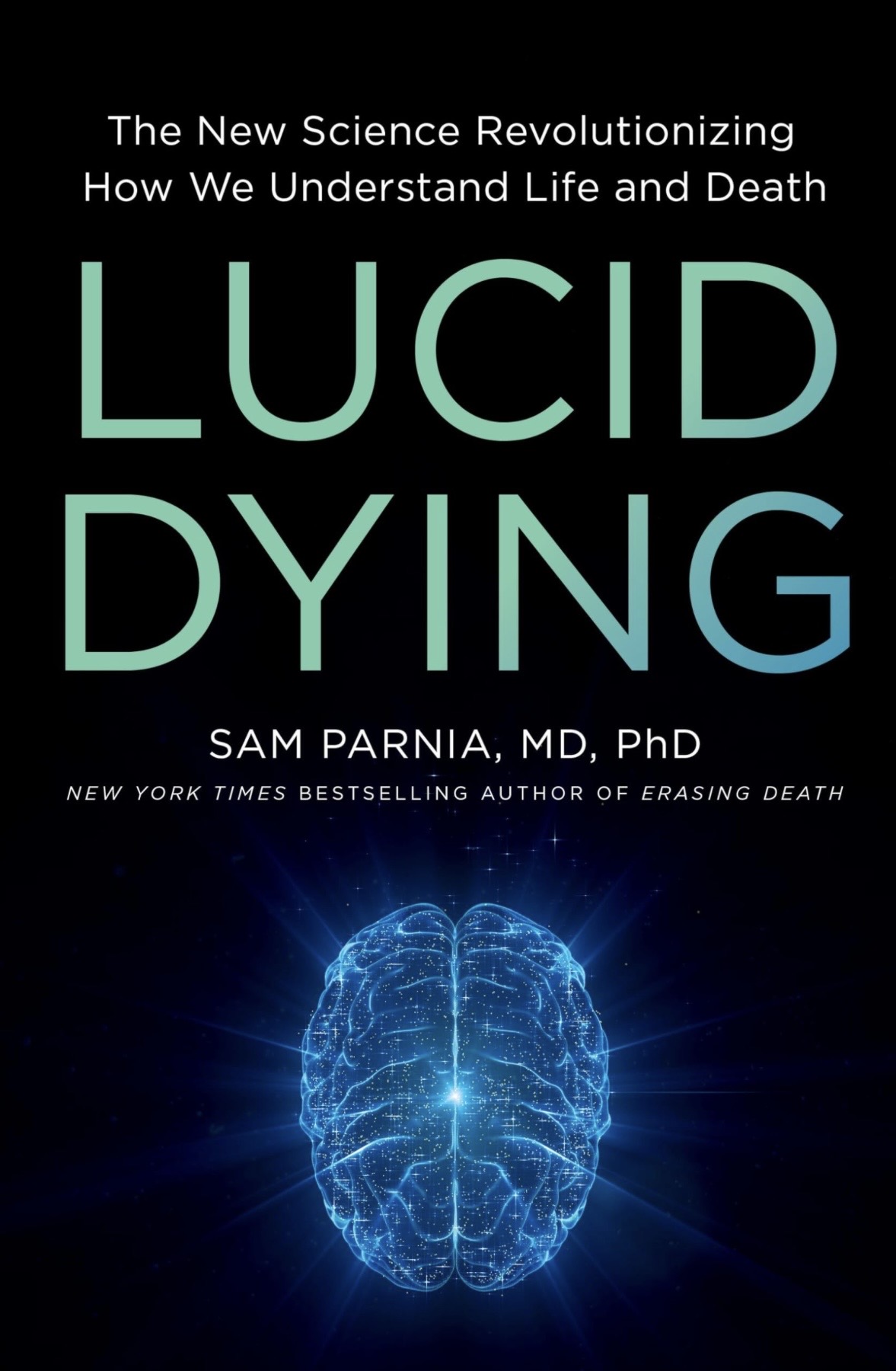
New York: Hachette Books, 2024. 342pp. ISBN: 9780306831287
The centrepiece of this book is its presentation of the findings of the AWARE-II study, of which the author, Sam Parnia, was lead scientist and director. AWARE-II was a collaborative study made up of thirty three leading scientists across twenty five major medical centres in the US and UK which was designed to monitor the brains of those who were dying and being resuscitated and which used state-of-the-art technology in order to do so. 567 persons receiving CPR were monitored and the testimonies of an additional 126 community survivors of cardiac arrest were collected from around the world. Specifically – and amongst other things – brain oxygen levels and brain electrical systems were measured second-by-second. Much of Lucid Dying is taken up with the results of this study, the results of which were first published in September 2023 and in which analysis of these persons’ experiences was made using grounded theory, Natural language processing and AI methods. The ambition can’t be faulted and the outcomes of the AWARE-II study make for absorbing reading, particularly when combined with the findings of an earlier study, AWARE-I, in which a much smaller database was obtained and analysed.
Several of these projects’ findings stand out, as does Parnia’s avoidance of the term ‘Near-Death Experience’ (NDE) in favour of ‘Recalled Experience of Death’ (RED): a substitution occasioned by the fact that he sees the former as a mislabelling. Indeed, for him, REDs are actually showing us what happens in that ‘grey area’ where the ordinary cognitive states of life give way to a ‘hyperconscious’ state occasioned by brain disinhibition as that self-same brain ‘dies.’ Remarkably, it appears that such states of hyperconsciousness can occur some time after the brain flatlines and the author cites his own and other studies as making clear that in some cases the brain can remain robust and hence theoretically revivable for staggeringly prolonged periods after it apparently ceases to function: several minutes or, in some cases, even hours.
The notion of disinhibition is key to Parnia’s overall thesis which includes the assertion that brain disfunction in that ‘grey area’ at the end of life can actually reactivate hitherto dormant parts of the brain, disclosing new ‘dimensions’ of reality. Several things follow from this, including dying persons’ enhanced awarenesses of what reality actually consists of together with a vivid, ‘cause and effect’ review of their actions – and the actions of others toward them – from within the life just passed. The latter can often lead to greater insight and knowledge, he writes; a sort of judgement in which ‘everyone seems to evaluate their life based on a universal set of ethical and moral principles.’
The reader might be feeling a creeping sense of déjà vu at this point. Haven’t we read all this before? After all, the term ‘Near-Death Experience’ as first coined by Raymond Moody in his 1975 book Life After Life is fifty years old this year and that makes for half a century of detailed, ongoing, research. And there is a very real sense in which we have read it all before inasmuch as many of the fifty or so elements reported by persons whose REDs make up the study are indeed identical or very similar to those found in the NDE literature generally: separation from the body, increased lucidity of thought (more on this later), the ‘life review’, encounters with a light or lights, acquiring knowledge of the future, and so on. In fact, very few motifs from earlier NDE ‘models’ are missing, I noted, apart from the ‘ringing’ or ‘buzzing’ noise from Moody’s original 1975 model (a motif which has, admittedly, had something of a patchy presence in the various NDE models presented both by he and other researchers over the last half a century). Parnia adds one or two others – such as the ‘cord’ joining the ‘new’ consciousness to the old ‘self’ – and gives fresh detail to some existing ones, but he doesn’t drop any real surprises in this regard.
The best parts of the book are the things Parnia presents which are genuinely new in either his own research or that of others: the fact that awareness can persist for so long in a flatlined brain, the fact that it consists, measurably, of delta waves, the fact that such activity can ‘spike’ several minutes after flatlining, and the clear and demonstrable difference between REDs on the one hand and dreams, hallucinations and imaginary creations on the other; this latter point shown convincingly via the computer-based mathematical modelling obtained via Natural language processing. The study also joins that small and growing number of books to have emerged in recent years which have sought to examine cognitive lucidity in cases where brains are damaged or deteriorated beyond the point where such should be possible. Hence it is possible to read Lucid Dying profitably alongside other studies which have sought to examine phenomena such as Terminal and/or Paradoxical Lucidity.
It is to Parnia’s credit that he avoids reductionistic explanations of the phenomena that he has done so much to uncover; preferring instead to view the brain as the mediator, rather than the producer, of consciousness. This puts him somewhat outside of the existing scientific consensus: a point which he returns to at various places within the book. He also seeks to locate his study within the context of philosophical and other studies dealing with the ‘hard problem’ of consciousness and the result is a refreshingly wide-ranging study which I recommend to anybody curious as to where such end-of-life research has taken us in the fifty years since Raymond Moody brought it to such broad, popular, attention.
This review first appeared in De Numine, Issue 78, Autumn 2025, pp. 43 – 4