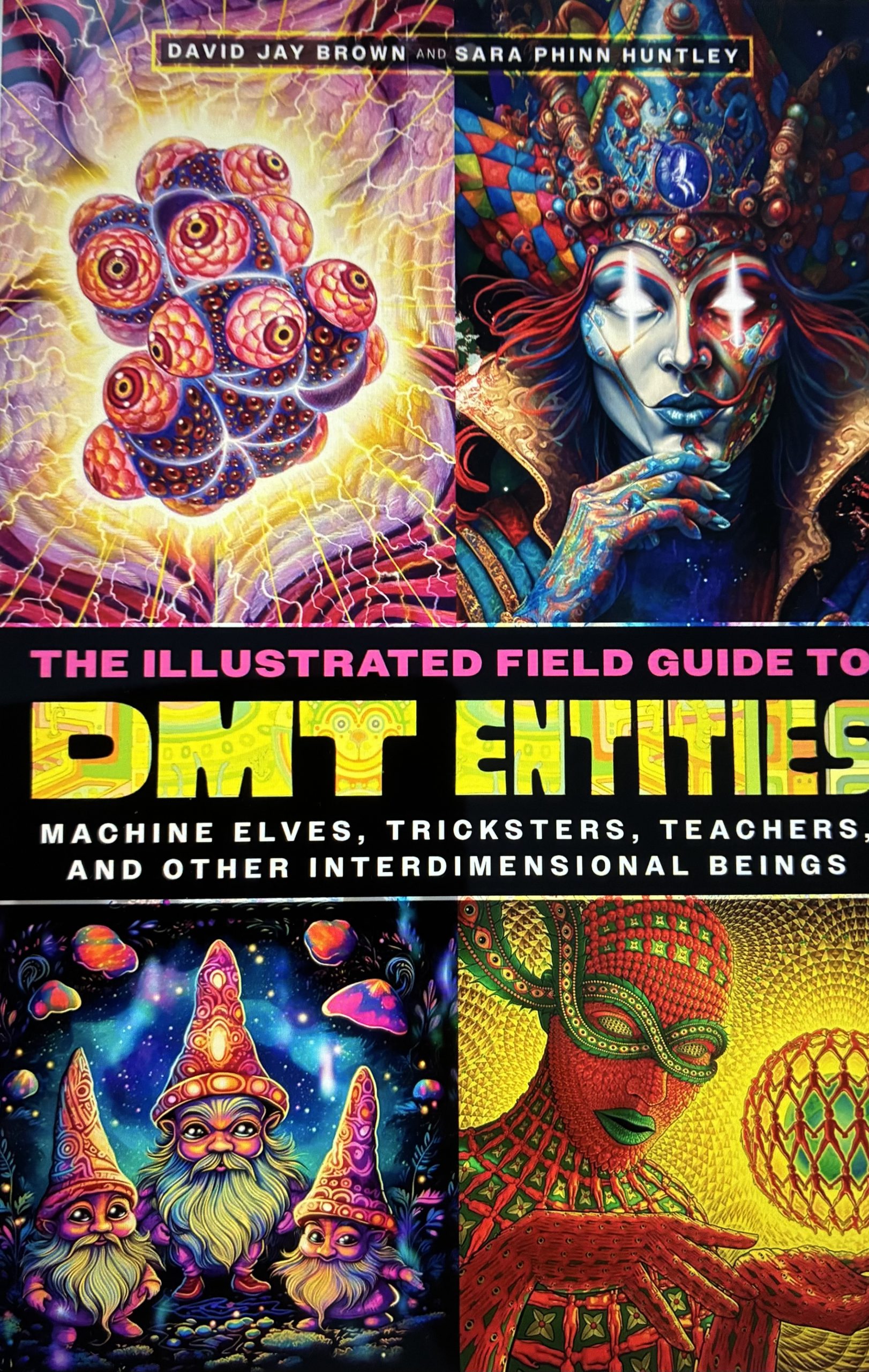
Park Street Press, Vermont, 2025. ISBN: 978-1-64411-919-8. Pbk: 336 pp.
N,N-DMT (usually abbreviated to DMT, for short) is a chemical found in the human body and the bodies of many species of animals and plants but never in insects. It is derived from tryptophan, an amino acid endogenous to most living organisms and is commonly encountered in the natural world. With rare exceptions and despite being found pretty much ubiquitously it is illegal to use and/or to possess DMT but having been distilled it can be smoked, otherwise insufflated or injected. This sumptuously-illustrated book describes the varieties of results that can be obtained via these processes.
Despite not appearing in the study’s title or subtitle, ‘varieties’ is an appropriate word to use, for, as with William James’ celebrated early-twentieth century attempt to collect and collate religious experiences into types, so too does this book: except it tries to do the same for DMT ‘trips.’ More specifically, it is centrally concerned to produce a taxonomy of the beings encountered within the variously-collected trips, with commentary and analysis – even illustrations – as appropriate. The result is, as the title suggests, a field guide to the beings encountered by DMT users (and some users of other psychedelics) and in the process it functions as an introduction to the whole practice of deliberately ingesting DMT together with the results for some users of doing this.
Much in the book was completely new to me and one thing I found to be of particular interest toward the beginning was the authors’ reference to other studies which have sought to link reported DMT experiences with other types of transcendent and/or anomalous experiences. Might there be any explanatory advantage, I wondered, in comparing DMT experiences with the experiences reported, say, by Near-Death Experiencers or those reporting UFO abductions? In the event I came away unconvinced that there would be: chiefly because the experiences reported by the respective ‘groups’ of experiencers turn out to be so utterly different. Vivid intimations of transcendent realms and encounters with ‘others’ may indeed be common to all, together with the subjective sense of ‘reality’ frequently reported, but there the similarities end. And even this is pushing it: for whilst encounters with deceased loved ones and/or religious figures are widely reported within Near-Death Experience testimonies, for example, they appear to be somewhat in the minority as regards DMT events. Ditto the widely-reported ‘grays’ of UFO close encounters. I say ‘appear’ because Brown and Huntley’s study is skewed more toward qualitative than quantitative analysis and it is therefore difficult to draw precise numerical and statistical conclusions from their work concerning the frequency with which certain types of beings are typically encountered by DMT users. And this is unfortunate, because the attempt at typology is far and away the most interesting part of the book and rightly where its emphases lie.
Hence in Part Two, ‘The Entities’, we are introduced to a wide and vividly-diverse range of encountered DMT ‘creatures’: Self-Transforming Machine Elves, Mantis Entities, Reptilians, Grays, Clowns, Jesters, Tricksters, Gatekeepers, Spirit Guides, Angels, Devils, Therianthropes, Ancestors, Kobolds, Plant Spirits, Snakes, Octopoid Beings, Mother Gaia, Beings of Light and – last but presumably not least – God. Note: this list is not exhaustive and I could have included just as many identifiers using the other categories listed and explored. Each category, as the book makes clear, is derived from experiencers’ own claims and their testimonies are quoted from at length. In addition, illustrations, many composed via the use of AI, are presented alongside the experiencers’ descriptions in order to ‘represent the collective experience of DMT archetypes’ as co-author and artist Sarah Phinn Huntley puts it. Taken together this all makes for a mind-blowing experience with the book bringing the reader as close as the law allows to having an DMT experience for him- or herself. And whilst it is not possible to reproduce any of the fine illustrations in this review, it is at least possible to give a brief flavour of some of its content by means of a testimony-extract. This, then, from a subject’s ‘encounter’ with a Mantis Entity:
‘Suddenly I was joined by a mantis shaped creature, not of this world. Mantis-like only in how the shape of its head and the angle and size of its body related to each other. I did not notice its appendages. It was calm and comforting, communicating to me through my thoughts. It had oversized humanoid eyes and an oversized mouth which all felt tacked on to its head, like a poor Photoshop job. It grinned at me like the Cheshire Cat and then showed me my mother and father, at which point I tried to look away. My vision drifted from left to right, away from my parents…and then it was over.’
It is difficult to glean from the wealth of testimonies included whether the experiences across the various types have anything in common. A few things, however, do seem clear. Most experiences are positive but some are not. Some contain images and presences previously familiar to experients whereas others do not. Some include details in which information is apparently conveyed to subjects whereas others include descriptions in which information was actually obtained from them. And so on. There is a reported playfulness to many of the encounters too – especially in the categories of Jesters and Tricksters – but even this is not invariant. It would certainly be hard to derive any kind of ‘common core’ across the wide range of experiences reported and it is to the authors’ credit that they do not seek to try and do so.
This would be an interesting read for readers interested in a range of related issues issues within the fields of spirituality, parapsychology, religious experience, after-death studies and science: at least up to a point. They will certainly encounter some familiar ground here – the presence of religious figures, for example, and the subjective reality of many of the transcendent experiences reported – but much that is unfamiliar, even grotesque, also. Overall, the experiences reported by DMT users lack the spontaneity of ‘authentic’ religious and spiritual experiences by virtue of the fact that they are deliberately induced: and this, of course, goes for other experiences derived from ayahuasca use and the like. Users and DMT scholars appear divided as to where DMT actually ‘takes’ subjects: to genuinely ‘other’ realms or somewhere within their own psyches hitherto unexplored. Ditto the beings encountered, and their reality or otherwise apart from the minds of DMT users is discussed at length early on. At times this all made me think of extant and ongoing discussions and debates surrounding religious and spiritual experiences reported in other contexts where drugs play no part in what happens: a reminder, perhaps, that the wide area of anomalous experiencing continues to be one in which much uncertainty remains.
This review first appeared in The Christian Parapsychologist, Vol. 3, No. 6, Spring 2026 pp. 40 – 3