In Search of a Definition
I could almost have called this: some things you might not know about Near-Death Experiences (and were always afraid to ask). Because fifty years on from the birth of the term ‘Near-Death Experience’ there is still a great deal of misunderstanding concerning what these experiences are and what they aren’t. As this paper will show: we have learned a lot over the last fifty years about Near-Death Experiences – or NDEs, as the initialism has it – and we can, at least, be clear on these things. But there is a lot we still don’t know. At some point – at various points actually – we will get onto unanswered questions. These are intriguing. I sometimes think the unanswered questions – precisely because they’re still unanswered – may be telling us as much about NDEs as the questions we do have answers to.
One thing is, however, very clear. The meaning and use of the term ‘Near-Death Experience’ has changed over the last fifty years. In recent years, for example, it has come to be used quite a lot to denote any situation of life-threatening danger that you managed to survive: being caught up in the chaos of a natural disaster such as a hurricane, for example, and living to tell the tale.
Here, I will not be using it like that. In fact, I’m going to use it in a very specific and completely different sense. So here is the first thing you may not know about Near-Death Experiences. Since its inception fifty years ago the term Near-Death Experience itself has come to be used – and frequently is used – in more than one sense.
So how am I going to use it here? Three-quarters of the way through the twentieth century, a philosophy lecturer turned medical doctor, Raymond Moody, actually coined the term ‘Near-Death Experience.’ Before his book Life After Life, published in 1975 by Mockingbird Press, the term didn’t exist at all[1]. And he coined it and used it in a very specific sense: to denote those odd and unusual experiences that people report when they’ve been near to death. In fact, some of those people report experiences that occurred even after they were pronounced clinically dead. Imagine that. Being dead but still being aware. Even hearing yourself being pronounced dead by the attending doctor.
The dullest book on Near-Death Experiences I ever read was the one that contained no actual examples of Near-Death Experiences at all. Just analysis. Page after page. It was actually about a range of unusual experiences. But the thing about these types of experiences – including Near-Death Experiences – is that it’s the examples that really: well, bring them to life.
So this is the second thing the reader may not know about Near-Death Experiences: if you really want to find out about them, you need to hear some accounts of them. Either at first hand or via the work of researchers like Moody who collected over 120 for his 1975 book and presented them apparently verbatim. In fifty years of research including the mass collecting of NDE reports we have no other evidence for such experiences. No pieces of the pearly gates. No photographic and/or any other images of the being of light at the end of the tunnel. Nothing apart from testimonies. Wanting anything more sounds absurd, of course. What other evidence could we possibly have? But it underlines a crucial point. If testimonies are all you have, then it is testimony-material you have to explain. This is crucial. And fifty years of research into NDEs and other so-called anomalous experiences has confirmed and reconfirmed a related point. Testimonies are not windows into experiences. They are not as straightforward as that. Testimonies are actually often complex artifacts. Constructions. They pass through stages of composition. They are usually reliant on in some sense eyewitness evidence: which can be and often is unreliable. And they can change depending on how you read them. Not for nothing was hermeneutics named after Hermes: the boundary-crossing Trickster god of the Greeks. Testimonies are tricky; slippery.
Tales from the ‘Other Side’
So, if testimonies are all we have – even fifty years on – we’re going to have to start with some. And why not start with some from Moody’s book, first published all those years ago? It’s a good thing, actually, given that they’re far and away the best part of his 1975 book. The examples. As a teenager I devoured them as if they were holy writ.
So let’s listen to some examples from Life After Life: just so we know what we’re going to be talking about. Here’s the first:
I was in the hospital but they didn’t know what was wrong with me. So doctor James my doctor sent me downstairs to the radiologist for a liver scan so that they could find out. First they tested this drug they were going to use on my arm since I had a lot of drug allergies but there was no reaction so they went ahead. When they used it this time I arrested on them. I heard the radiologist who was working on me go over to the telephone and I heard very clearly as he dialled it. I heard him say “Dr James I’ve killed your patient Mrs Martin.” And I knew I wasn’t dead. I tried to move or to let them know, but I couldn’t. When they were trying to resuscitate me I could hear them telling how many CC’s of something to give me but I didn’t feel the needles going in. I felt nothing at all when they touched me.
And this is often how Near-Death Experiences – I’m going to say NDEs for short – typically start. What happens next? Often, this:
I began to experience the most wonderful feelings. I couldn’t feel a thing in the world except peace, comfort, ease – just quietness. I felt that all my troubles were gone and I thought to myself, “Well, how quiet and peaceful, and I don’t hurt at all.”
So, according to Moody, dying was nothing to be feared. Quite the opposite. But there was more. As one of Moody’s respondents told him:
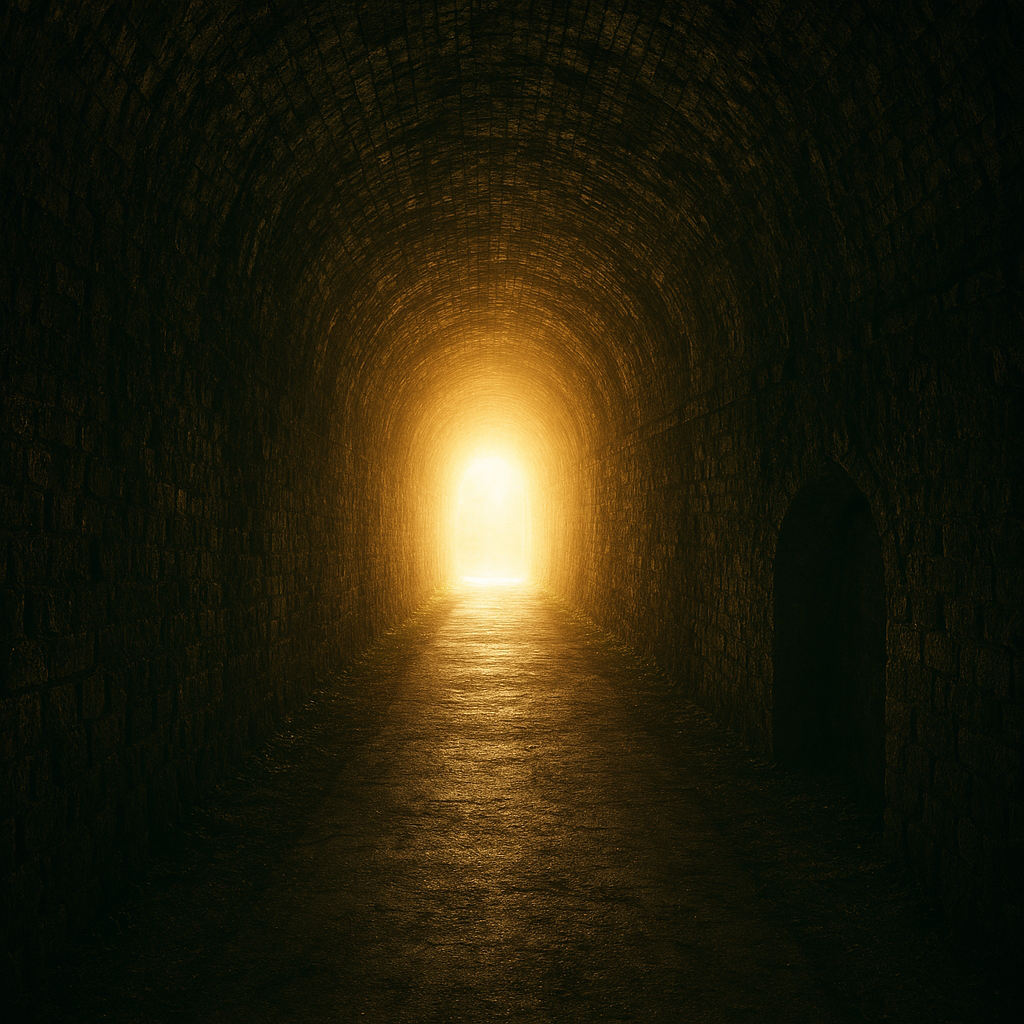
I had a very bad allergic reaction to a local anaesthetic and I just quit breathing. I had a respiratory arrest. The first thing that happened – it was real quick – was that I went through this dark black vacuum at super speed. You could compare it to a tunnel, I guess. I felt like I was riding on a roller coaster train at an amusement park going through this tunnel at a tremendous speed.
This, then, is a Near-Death Experience: hearing yourself being pronounced clinically dead, feeling wonderful, entering a period of darkness. But there’s more. Listen to what this car crash victim told Moody:
I heard this awful sound – the side of the car being crushed in – and there was just an instant during which I seemed to be going through a darkness, an enclosed space. It was very quick. Then, I was sort of floating about five feet above the street, about five yards away from the car, I’d say, and I heard the echo of the crash dying away. I saw people come running up and crowding around the car, and I saw my friend get out of the car, obviously in shock. I could see my own body in the wreckage among all those people, and could see them trying to get it out. My legs were all twisted and there was blood all over the place.
And there it is. The out-of-body experience. Very often reported by people as part of their Near-Death Experiences. Moody reported a lot of examples of out-of-body experiences in his book. Here’s another example he cited:
As my being went out of my body it seemed that a large end left first and the small end last… It was a very light feeling – very. There was no strain on my body; the feeling was totally separate… The most striking point of the whole experience was the moment when my being was suspended above the front part of my head. It was almost like it was trying to decide whether it wanted to leave or to stay. It seemed then as though time were standing still…
As interesting as all of this is, we can’t leave our description here. There’s more to the Near-Death Experience, even than this. In fact, you may consider the next testimony-extract the most moving of all. The respondent told Moody:
I had this experience when I was giving birth to a child. The delivery was very difficult and I lost a lot of blood. The doctor gave me up, and told my relatives that I was dying. However, I was quite alert through the whole thing, and even as I heard him saying this I felt myself coming to. As I did, I realised that all these people were there, almost in multitudes it seems, hovering around the ceiling of the room. They were all people I had known in my past life, but who had passed on before. I recognised my grandmother and a girl I had known when I was in school, and many other relatives and friends. It seems that I mainly saw their faces and felt their presence. They all seemed pleased. It was a very happy occasion, and I felt that they had come to protect or to guide me. It was almost as if I were coming home, and they were there to greet or to welcome me. All this time, I had the feeling of everything light and beautiful it was a beautiful and glorious moment.
We could end here and get on with our analysis. After all, what could top this? But there’s more, and I’ve saved the best till last. In perhaps the most dramatic testimony-extracts he presented, Moody gave us this:
I got up and walked into the hall to go get a drink and it was at this point as they found out later that my appendix ruptured. I became very weak and I fell down. I began to feel a sort of drifting, a movement of my real being in and out of my body, and to hear beautiful music. I floated on down the hall and out the door onto the screened in porch. There, it almost seemed that clouds, a pink mist really, began to gather around me, and then I floated right straight on through the screen, just as though it weren’t there, and up into this pure crystal clear light, an illuminating white light. It was beautiful and so bright, so radiant, but it didn’t hurt my eyes. It’s not any kind of light you can describe on earth. I didn’t actually see a person in this light and yet it has a special identity, it definitely does. It is a light of perfect understanding and perfect love.
And there it is. The Being of Light, as Moody termed it. Or Him. Or Them. Or Whoever. Actually, Moody made clear that he thought the Light was a constant but it was overlaid or wrapped around or interpreted in terms of a particular person’s faith and/or background. So a Buddhist might call the light Shunyata. A Jewish person might describe it as an angel. An atheist might simply call it a Being of Light. We’ll have much more to say about this because the last fifty years have told us something about the prevalence of NDE testimonies in a variety of cultures globally. NDEs are not just a so-called Western phenomenon. They seem to crop up everywhere.
Anyway, for now: there we have it. The Near-Death Experience. And how do we know about this experience? Because, of course, every person who apparently died didn’t stay dead. Medical science is a wonderful thing and has come on leaps and bounds over the last half a century. This goes for resuscitation techniques just as it does for very many other aspects of health care. At this point in time – 2025 – we have a massive number of NDE testimonies. What J. Allen Hynek once said about UFO reports can absolutely be said about NDE reports: we are embarrassed by our riches. And even fifty years ago each of the temporarily dead that Moody spoke to returned – but with a tale. And sometimes that tail had a sting in it, for, as one of his respondents told him:
After I came back I cried off and on for about a week because I had to live in this world after seeing that one. I didn’t want to come back[2].
Confirming Moody
An obvious question presents itself at this point. What about others? Did anybody else try to replicate Moody’s findings? If so, what did they find? And the answers to these questions bring us bang up to date. Because in the fifty years since Moody’s groundbreaking study a large number of other researchers have interviewed many thousands of brought back, near-death survivors and have found…well, in many cases exactly what Moody found. People told and continue to tell of episodes at or near the point of clinical death in which they heard themselves being pronounced clinically dead, felt bliss and peace, journeyed through darkness, saw their own bodies as if from outside, met with deceased relatives and friends, and encountered a light-being (variously-described) before returning to life: often reluctantly and only sometimes by choice. I could list the names but it would take a very long time. Back in the early post-1975 days the researchers who confirmed Moody’s findings were people like Ken Ring, Michael Sabom, Margot Grey, and many others. In more recent years they have been joined by researchers such as Penny Sartori and Sam Parnia. In between there have been ‘constants’ in the field such as Peter Fenwick and Bruce Greyson[3]. This list is absolutely and in no way exhaustive. But what each contributor to the field seems to have confirmed and reconfirmed is this: something is going on. It really is. Similar fact evidence indeed. The question is, of course: what’s going on?
Other Cases
And that, as they say, is the $64,000 dollar question. Or Yen. Or pounds sterling. Or Bhat. Or Euros. Or whatever. Because, as I alluded to earlier, fifty years of research have showed that NDEs are reported all over the place, by people of all creeds and colours, of all religions and none. What you believe might – might – shape the experience you have but it doesn’t seem to dictate whether you’ll have an experience or not. What you believe – or, indeed, don’t believe – doesn’t seem to have any bearing on whether you have an NDE. Moody found this early on and other researchers – Ken Ring, Michael Sabom, Bruce Greyson, me, and hundreds of others – have all found more-or-less the same thing.
Much more could be said and considered here, here, including the research of Allan Kellehear and others who have explored this cross-cultural path. But time is moving on and there’s another particular path I’d like to explore. Fifty years of research is a long time, after all. Any presentation has to be selective and there is so much that is interesting. And here, it becomes tragic.
On May 3rd, 2007, in Praia da Luz, Portugal, Madeleine McCann, tragically, disappeared. All of you, I’m sure, are familiar with that terribly sad case and the devastating impact on the parents, Kate and Gerry. A while ago I was reading Kate McCann’s book about it and came across a little-known detail about the aftermath. Five days after Madeleine’s disappearance, according to Kate, Gerry McCann was praying in the local chapel at Nossa Senhora da Luz when he had, in Kate’s words, ‘an extraordinary spiritual experience.’ She goes on to write: ‘He suddenly became aware of a long tunnel with light at the far end of it. He felt himself enter the tunnel and, as he went deeper and deeper inside, it became wider and wider and brighter and brighter. He had never known anything like this before…’[4]
We don’t have Gerry’s own description of the event but its essence – an extraordinary spiritual experience involving a tunnel being traversed toward light – is clear from Kate’s description. Yet as far as can be determined Gerry was nowhere near actual physical death at the time: although the depth of the crisis in which he found himself during those dreadful days can scarce be imagined.
And consider the following testimony which I uncovered for a book I published back in 2008 on unusual experiences of light generally:
A friend, knowing I was in emotional distress, had asked me to pray ‘for a fortnight’ at least, as a ‘trial’ of prayer. At the end of the fortnight, as it happened, I was at the concert with a friend given by the Halle Orchestra. They were playing the Choral Symphony (Beethoven) and as I did not know the music well I had retreated into my own thoughts – which were pretty depressing. I prayed to be taken out of the ‘black pit’ of my own mind and selfishness and suddenly, in answer, there was a rush of light which surrounded me…and at the same time seemed to melt my physical being so that light welled up also from within me or rather burst out of me to meet the light that was without. With this light came bliss, happiness a million times stronger than anything that I had experienced on earth: and on earth I had been at times completely happy. At the same time I felt a cool breeze playing on me and within me a whirling sensation and a feeling that I was somehow above myself – my body…
And consider another testimony I uncovered during research for that same book. The subject, three months after a miscarriage, was, as she writes, ‘near despair as I was walking down the country road to do the shopping in the village.’ Then it happened:
Suddenly I was enveloped (I can only call it that) and lifted high above the high bank and tall hedge on top as though by unseen and unfelt hands, enveloped in a wonderful living brilliant light. I saw a small deserted quarry or cutting below, but everything, plants, bushes, even the stones on the far side were exuding a pulsating life and bathed in an unearthly bright golden light. It seemed an eternity I was held aloft with the most wonderful glow of peace and awareness of the wonder of God.
Then I found myself standing on the road and looking to see if anyone had seen me, it was so vivid, no-one was in sight. I walked on to the shops but with an unutterable feeling of peace within me my longing for another child just disappeared.
And there is a postscript to this experience, which the subject adds and which I will also read:
A few days afterwards, as the bank and hedge were too high to look over, I found by going up a side path I could look down, and it was as I had seen it, only the scene was just normal. We were newcomers to the area, and I had never wondered what was behind the high bank and hedge.[5]
Combining the extracts we’ve just read, and beginning with Gerry McCann’s experience, we have descriptions of extraordinary events including feelings of peace, the traversing of a tunnel toward light, an encounter with light and vivid out-of-body experiences, one of which being later dramatically verified. Exactly the same as the so-called ‘core components’ of the Near-Death Experience. But these people were nowhere near death.
And hence we come to another thing that has become clear over the last fifty years of research into Near-Death Experiences: you do not need to be near death to have one. Or at least the key components of one. Although a state of crisis does seem to help. I’m going to leave this alone, now, and consider Near-Death Experiences in the sense of those peculiar experiences reported by persons in specifically end-of-life situations. But, in passing, it is useful – and perhaps instructive – to note the existence of similar kinds of experiences where there is no apparent threat to life at all. We knew about these experiences – out-of-body experiences and so on – before the modern era of NDE research. Yet they seem to appear as reported components within NDE testimonies too. They certainly have over the past half-century. Perhaps the ‘Near-Death’ within ‘Near-Death Experiences’ is something of a mislabelling. Or perhaps something more is going on.
Out-of-Body Experiences
In fact, we might usefully stay with the out-of-body aspect of Near-Death Experiences for a little while. The literature is full of examples of persons making observations whilst out of their bodies which, as with the lady who saw what was behind the bank and hedge, later turned out to be correct. In one celebrated case, for example, first reported in 1998, a musician, Pam Reynolds, deliberately rendered clinically dead prior to an operation to remove a basilar artery aneurism from her brain, reported seeing whilst apparently out of her body in the operating theatre something that [quote] ‘looked like an electric toothbrush and it had a dent in it, a groove at the top where the saw appeared to go into the handle, but it didn’t…And the saw had interchangeable blades, too, but these blades were in what looked like a socket wrench case…’ Given that she was unconscious when wheeled into the theatre and didn’t regain consciousness until she was out of it, this observation appears remarkable. But what did Pam Reynolds actually see? Researcher Michael Sabom examined the case in detail and determined that one of the tools used in the operation to remove the aneurysm from Reynolds’ brain was a Midas Rex Bone Saw: an instrument that corresponded remarkably well with Reynolds’ description of the mystery object. Yet how could she have seen the tool – with which she had previously been completely unfamiliar – whilst unconscious throughout the operation, unless she had been somehow ‘apart’ from herself?[6]
This is a famous case within the annals of Near-Death Experience research: one of the most famous to have appeared within the last fifty years. Anecdotal, of course, but held up alongside equally anecdotal cases as a kind of ‘proof’ that (a) human beings possess some kind of ‘soul’ and (b) as a kind of proof that when the brain stops working the soul escapes: albeit, in Reynolds’ case, temporarily.
But is it really as straightforward as that?
Incorrect Observations
One remark made by UK near-death researcher Penny Sartori is of particular note at this point. Just a few years ago she did something very interesting. She gained access to the Intensive Care Unit at a local hospital and placed objects at strategic points but high up: that is, only visible if a person was somehow floating ‘above themselves’ at the time. She waited for a period of time and then checked to see (a) if anybody had an out-of-body experience in the ICU during the period of the experiment and (b) if they identified any of the particular objects. She did find some reported out-of-body experiences during the experimental period but not one of those persons correctly identified the hidden objects. Not one. And this, indeed, has been the result of every single ‘hidden object’ study that has ever been carried out anywhere in the world, ever. It’s a bit like looking for William James’ elusive white crow. The existence of such would be enough to disprove the contention that all crows are black. It would put the matter beyond dispute. But was there ever such a thing? In the same way: just one veridical NDE – or out-of-body experience – in which accurate and verified observations were made by subjects of their surroundings whist allegedly out of their bodies would serve to put the matter beyond doubt. The NDE equivalent of a white crow, indeed. But do we have one? No. We do not. Even after fifty years of near-death studies. What is that telling us?
But there’s another aspect of Penny Sartori’s findings that I want to draw attention to here. She writes that one patient who reported an NDE accurately described events that occurred around her while she was apparently out of her body but also made incorrect observations as well: specifically, of a piece of jewellery pinned to her hospital gown. This was simply incorrect, Sartori asserts, as no jewellery is allowed into any operating room and strict checks are undertaken to ensure that this instruction is complied with. Sartori concluded that the drugs given to this patient might have led to this misperception, which might therefore have simply been hallucinated by the patient.[7]
However, this is by no means an isolated case. Writing in the peer-reviewed Journal of Near-Death Studies researcher Keith Augustine has made much of these incorrect observations in NDE testimony. One case he has cited was collected during a study of Near-Death Experiences conducted at Evergreen State College in Washington and concerned a woman who had a ruptured Fallopian tube. Describing her observations whilst apparently apart from her physical body she described how:
“I saw this little table over the operating table. You know, those little round trays like in a dental office where they have their instruments and all? I saw a little tray like that with a letter on it addressed (from a relative by marriage she had not met).”
Remarking that there was, in fact, neither a letter nor such a round table in the operating room, Augustine concludes that this is further evidence that the experience was hallucinated and that audible ‘cues’ in the operating theatre provided the input from which the hallucinated scenario was constructed. Another case that Augustine cites is taken from the research of Peter and Elizabeth Fenwick and involved an NDE that occurred during World War Two when a soldier was attacked by aerial bombers. In this instance, despite seeing himself on the ground from a clear vantage point apparently above his physical body he completely failed to observe two Sudanese persons who were plainly lying beside him in what should have been full view to anyone ‘hovering’ above. Only when back in his normal physical surroundings did he see them and it was at this point that he also realised that a Bren gunner who had been beside him had disappeared: something else that he had failed to register whilst apparently out of his body. Augustine has made much of these and other cases he has collected in which persons make observations whilst outside of themselves which later turn out to be wrong, and this has, for him, helped to build a case for seeing NDEs as essentially hallucinatory.[8]
Augustine’s sceptical view is understandable. Yet it fails to explain what the anecdotal evidence examined above at least implies. That for all the things they may get wrong Near-Death Experiencers also make at least some observations that appear to be remarkably correct. How, then, might we account for this curious combination of ‘hits’ and ‘misses’?
This has interested me a lot in recent years. Important to note is that this ‘mix’ is very reminiscent of what is frequently reported in parapsychological literature generally. Mediums, for example, often deliver readings in which apparently – and at times startlingly – correct information about sitters is mixed with rather basic errors. Whilst sceptics simply explain this away in terms of simple fraud or by ‘cold readings’ of individuals by the mediums it is hard to invoke this explanation in the case of NDEs. It seems that any attempt to solve this as-yet unexplained puzzle within NDE testimony must take the form of some kind of new paradigm which at the very least makes sense of this curious mix of both ‘hits’ and ‘misses’: both within NDEs and elsewhere. At that is a challenge: one for the next fifty years of near-death research, perhaps.
For now, though, we note one further thing that the last half-century of NDE studies has revealed: for all their remarkably correct observations, people who have Near-Death Experiences get things plain wrong too. And related to this we may observe: this interesting mix of ‘hits’ and ‘misses’ is replicated elsewhere within paranormal literature. In observations of the ‘success and failure rate’ of mediums, for example. Whatever could this mean?
Departures, Arrivals, and C.S. Lewis
I have been a been a member of the CFPSS for roughly half of the last half-century. The fellowship is a good ‘fit’ for my own research interests, given that I’m keen to explore issues at the interface of parapsychology on the one hand and a broadly Christian theology on the other. And so inevitably, over the course of the last few years, I’ve found myself wondering about how to approach Near-Death Experiences from a Christian perspective.
You may think that the last fifty years has been replete with studies of NDEs from a variety of broadly theological perspectives: including those of Christian theology. And whilst some studies there have certainly been, I think it is fair to say that the number of them has not been overwhelming. Part of my own contribution to the research field, therefore, has been to seek to add to that number.
To this end, three or four years ago I began to wonder: what might an outstanding Christian apologist such as C.S Lewis make of NDEs? It is unclear if Lewis knew anything about what we would today call ‘Near-Death Experiences’ and, of course, he certainly would have had no way of knowing the term itself but I found myself wondering if some bridges might be made between NDEs on the one and some of the other things he did write about. Mysticism, perhaps.
This research avenue proved quite fruitful. For example: writing in a posthumously-published book, Prayer: Letters To Malcolm, Lewis notes that during their experiences mystics leave behind their usual ways of experiencing and being: a ‘leaving behind’ that is necessary if room is to be made for the transformed state of being that follows. Viewing this ‘leaving behind’ firstly in terms of emptying, Lewis uses an unusual analogy, writing that – and again I quote – ‘If wine-glasses were conscious, I suppose that being emptied would be the same experience for each, even if some were to remain empty and some to be filled with wine and some broken.’ Following this with a very this-worldly analogy – that of embarking on a sea voyage – he turns to the motif of departure, writing: ‘All who leave the land and put to sea will ‘find the same things’ – the land sinking below the horizon, the gulls dropping behind, the salty breeze. Tourists, merchants, sailors, pirates, missionaries – it’s all one.’ Thus, as with emptyings, departures may easily be seen to share certain things in common.
Crucially, though, Lewis asserts that emptyings, and especially departures, must not be confused with destinations. Hence, and again addressing mysticism, he writes: ‘I do not at all regard mystical experience as an illusion. I think it shows that there is a way to go, before death, out of what may be called ‘this world’ – out of the stage set. Out of this; but into what?’ It is the into what that is key. Departures may indeed share things in common, Lewis says, but this tells us nothing about what awaits at the end of each respective mystical journey once ‘this world’ has been left behind.
It is here, perhaps, that the relevance of Lewis’s insights into mysticism for the understanding of Near-Death Experiences might lie. For surely, like the mystic, the Near-Death Experiencer has in some sense embarked on a process of departing. Hence, just as the mystic ‘traveller’ is engaged on a journey which entails the leaving behind of any ‘normal’ sense of ‘spatial and temporal consciousness’, so, too, the Near-Death ‘traveller.’ How could it be otherwise? In a situation where the body’s various systems and sub-systems have begun to shut down we could hardly expect the continuation of ‘ordinary’ states of consciousness: a fact which Near-Death Experiencers’ testimonies vividly show.
In fact, we can go further. Because we might even see this ‘shutting down’ process as in some sense akin to emptying. But it is the leaving behind process that I want to stay with here. As we have just seen, Lewis reminds us that all departures bear ‘family resemblances.’ Why, then, would we expect the departures described by persons having Near-Death Experiences to be any different? And, in fact, as we saw at the beginning of this session, the ‘departures’ described in Near-Death Experiencers’ testimonies do indeed bear striking family resemblances: with recurrent descriptions of bliss, tunnels, lights, out-of-body experiences, and so on.
But surely, objects the sceptic, these are just ‘tricks’ of the brain? For Lewis, this is to miss the point; certainly as regards mysticism. Hence, he writes: ‘I shouldn’t be at all disturbed if it could be shown that a diabolical mysticism, or drugs, produced experiences indistinguishable (by introspection) from those of the great Christian mystics. Departures are all alike; it is the landfall that crowns the voyage.’
‘Departures are all alike; it is the landfall that crowns the voyage.’ [Emphasis mine]
And herein lies the crux of the whole matter for our present purposes. Whatever the processes may be which may be occurring in a dying brain, these tell us nothing about where the Near-Death Experiencer actually goes. That is hidden: up ahead, around the corner, over the brow of the hill, out of sight. And please note: in saying this I in no sense intend to denigrate the experiences of those who have embarked on their voyages, only to (temporarily) return. Far from it: according to the very many accounts we have from Near-Death Experiencers, the emptying involved in this particular setting-out is wonderful; the departure both blissful and thrilling. I think that Lewis, had he written about Near-Death Experiences, might have said something like: should God, in His grace, have afforded His creatures such experiences as they leave His world, I wouldn’t be at all surprised. But up ahead lies something infinitely greater still. A landfall that none has seen. A crowning of the voyage unfathomably wonderful.[9]
Departures, then. But what of destinations?
Near-Death Experiences and the Christian Hope
It has seemed to me over the last fifty years that the thing which has excited many people about Near-Death Experiences is the possibility they offer of proving life after death. When I was fifteen, faithless, heir to no discernible religious or spiritual tradition, it’s what excited me. Hope. For something up ahead. For something beyond this life. And in an increasingly faithless age, it is easy to see that appeal as only increasing over the coming years. Hence the enduring popularity of Near-Death Experiences will remain.
But what of faith? Of the Christian faith in particular? What might CFPSS members really hope for? What kind of life after death does faith promise?
To answer this set of related questions I would like to compare and contrast three, final, testimonies. Firstly, two from Moody’s 1975 book. The book, you will recall, that gave us the term ‘Near-Death Experience’ almost fifty years ago. Here is the first:
The doctors and nurses were pounding on my body to try to get Ivs started and to get me back, and I kept trying to tell them, “Leave me alone. All I want is to be left alone. Quit pounding on me.” But they didn’t hear me. So I tried to move their hands to keep them from beating on my body, but nothing would happen. I couldn’t get anywhere. It was like – I don’t really know what happened, but I couldn’t move their hands. It looked like I was touching their hands and I tried to move them – yet when I would give it the stroke, their hands were still there. I don’t know whether my hand was going through it, around it, or what. I didn’t feel any pressure against their hands when I was trying to move them.
And here is the second:
People were walking up from all directions to get to the wreck. I could see them, and I was in the middle of a very narrow walkway. Anyway, as they came by they wouldn’t seem to notice me. They would just keep walking with their eyes straight ahead. As they came real close, I would try to turn around to get out of their way but they would just walk through me.
Incredibly, these people sound like…well, like for a while they were…ghosts…
Recall:
‘..they didn’t hear me.’
‘I tried to move their hands to keep them from beating on my body, but nothing would happen.’
‘I didn’t feel any pressure against their hands when I was trying to move them.’
‘…as they came by they wouldn’t seem to notice me.’
‘…I would try to turn around to get out of their way but they would just walk through me.’[10]
Now let us compare a third and final account. From Luke’s gospel, chapter 24, verses 36 – 43. Another account of a person who died but still lived:
While [the disciples] were still talking…. [the risen] Jesus himself stood among them and said to them, “Peace be with you.” They were startled and frightened, thinking they saw a ghost. He said to them, “Why are you troubled and why do doubts rise in your minds? Look at my hands and my feet. It is I myself! Touch me and see; a ghost does not have flesh and bones as you see I have.” When he had said this he showed them his hands and feet. And while they still did not believe it because of joy and amazement, he asked them, “Do you have anything here to eat?” They gave him a piece of broiled fish, and he took it and ate it in their presence.” (Luke 24: 36 – 43).
The contrast is clear: as, I hope, is the point. Perhaps it is to Jesus – the risen Jesus – that we should look as our ultimate destination. Certainly that is where Christians would be expected to look. Departures are all alike, said Lewis. Perhaps our arrivals after death are too. Not as disembodied and wraith-like ghosts but as solid, substantial. Capable of being seen and touched. Capable of eating fish. Risen.
Because this, surely, is the ultimate Christian hope. Not simply for the ‘escape’ of the soul, but for the resurrection of the body. Paul talks of Jesus as the ‘firstfruits.’ He was the first, Paul seems to be implying; and his resurrection guarantees that ours will surely follow. Resurrection, that is, not escape. After all, as theologian Oscar Cullmann once declared: there is no need for Easter if we are all immortal.
Perhaps some way might be found to combine both things. Perhaps in these Near-Death Experience testimonies we’re viewing something like the foothills of resurrection. A peep into what comes next, perhaps, rather than a view of the true towering peaks that await. Departures, rather than arrivals, with our eternal destination still, gloriously, to come.
Bibliography
Augustine, Keith: ‘Near-death experiences with hallucinatory features.’ Journal of Near-Death Studies 26 (1): 3 – 31 (2007)
Fox, Mark. Religion, Spirituality and the Near-Death Experience. London: Routledge, 2003
————-. Spiritual Encounters With Unusual Light Phenomena: Lightforms. Cardiff: University of Wales Press, 2008.
————-. ‘The Other Side of Death: C.S Lewis and Near-Death Experiences’, Psychical Studies, No 103, Winter 2023, pp. 18 – 23
Lewis, C.S. Prayer: Letters To Malcolm: Glasgow: Collins, 1963
McCann, Kate. Madeleine. London: Transworld, 2012
Moody, Raymond. Life After Life. Atlanta: Mockingbird, 1975
Rivas, Titus, Anny Dirven & Rudolf Smit. The Self Does Not Die: Verified Paranormal Phenomena from Near-Death Experiences: North Carolina, IANDS, 2016
Sartori, Penny. The Wisdom of Near-Death Experiences: Cardiff, Watkins, 2014
[1] Moody, Life After Life
[2] Ibid., pp 19 – 107
[3] For a more detailed overview see Fox, Religion, Spirituality and the Near-Death Experience, pp. 13 – 54
[4] McCann, Madeleine, pp. 150 – 1
[5] Fox, Lightforms, pp. 104 – 8
[6] On this and related cases, see Rivas, et al, The Self Does Not Die pp. 95 – 108
[7] Sartori, The Wisdom of Near-Death Experiences, p. 108
[8] Augustine, ‘Near-death experiences with hallucinatory features’
[9] Fox, ‘The Other Side of Death: C.S Lewis and Near-Death Experiences’
[10] Moody, op cit, pp. 47 – 55
This paper was given as part-celebration of the 50th Anniversary of the Christian Parapsychologist, a journal of the Churches Fellowship for Psychical and Spiritual Studies. It first appeared in print in Looking Beyond: Celebrating 50 Years of The Christian Parapsychologist Journal, Mansfield: The Christian Fellowship for Psychical and Spiritual Studies, 2026, pp. 35 – 62.