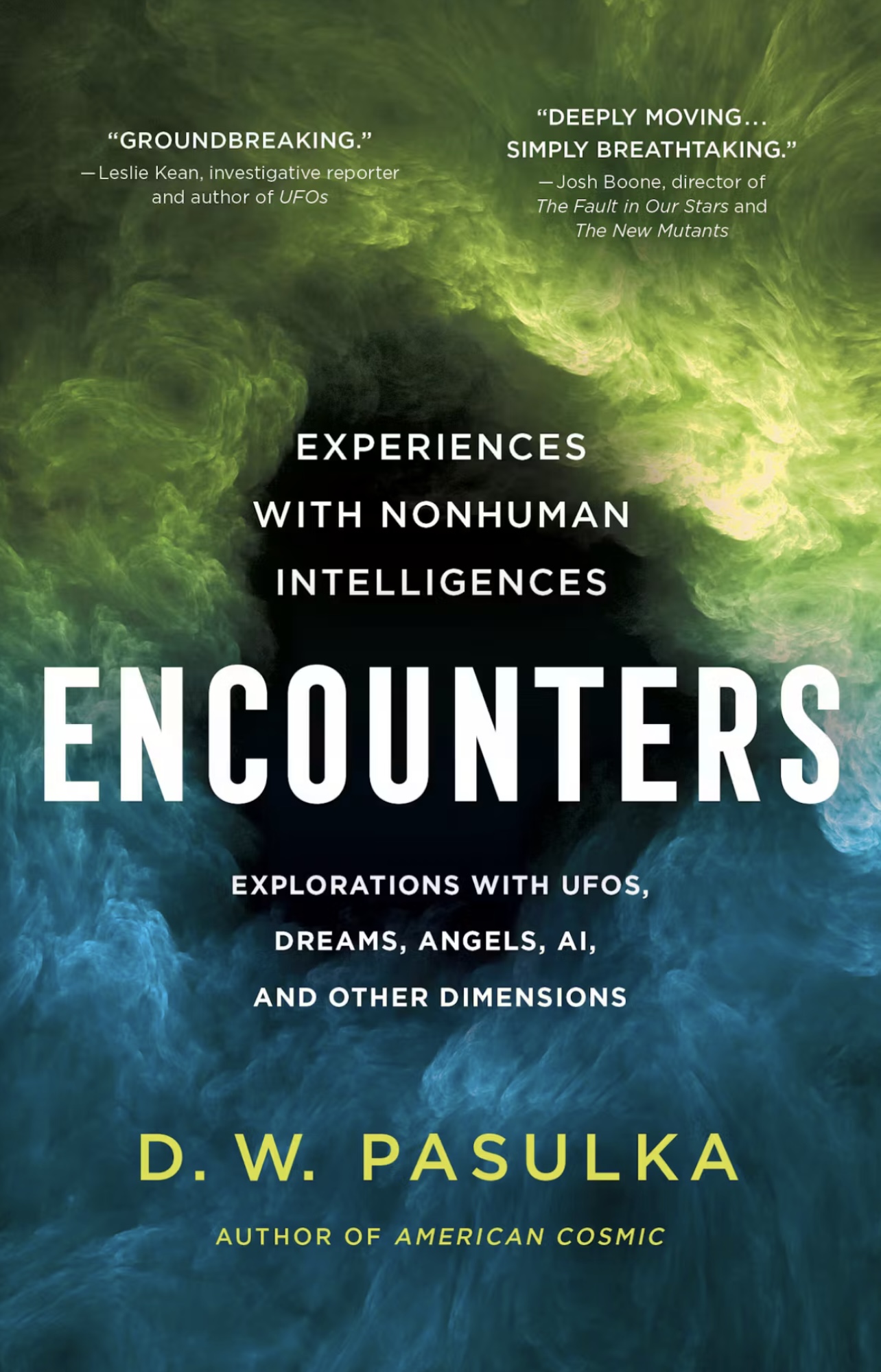
St. Martin’s Publishing Group, New York, 2023. ISBN: 978-1-250-87956-1. Hardback: 248 pp.
This, D.W Pasulka’s second book-length foray into UFOlogy, isn’t actually about UFOs per se. As the subtitle implies, it’s about a range of experiences with nonhuman intelligences and the book consequently extends to a variety of reported events in which encounters with intelligent – or seemingly intelligent – ‘others’ have been claimed: from angels and demons right the way through to AI and alien spacecraft occupants. What draws everything together in this and her previous book is Pasulka’s academic background as professor of religious studies at the University of North Carolina, Wilmington, and hence there is an emphasis on religion and spirituality here; specifically upon the ways in which UFOs and UFO encounters might be seen as religious and spiritual experiences. It’s a topic that the author keeps turning back to and might usefully be seen as the thread which holds this latest person-centred study together.
As a refugee from academia sharing Pasulka’s interest in the religious and spiritual dimensions of UFOlogy I found her study to be of particular interest for I have long thought that this theological perspective on UFOs has been neglected within the UFOlogical literature generally. Hence the fact that this book exists at all is, for me at any rate, a cause for celebration, and key to much of what the author writes is her oft-repeated contention that experients often attribute to their UFO encounters a spiritual significance. This certainly emerges from many of the interviews with witnesses that form the centrepiece to her study and herein she scents a conspiracy of sorts: for, she claims, ‘the public narrative of UFOs’ has been managed at various levels to exclude the spiritual aspects of UFO events, including those levels occupied by scientists and the mass (and social) media. To be clear, she is talking about the US here, but it would not be difficult to extend this context out into a wider Western ‘sphere’ and even, perhaps, beyond.
My problem with the ‘media-has-excluded-the-spiritual-aspect-of-UFOlogy’ argument is that it doesn’t quite fit the facts: particularly as reported within the UFO literature itself. Granted, some claimed UFO encounters as presented in that literature are overlaid with spiritual and religious imagery and the reported aftermath of such events can sometimes include an increased concern with spiritual and religious realities but not always. In fact, my conclusion after reading hundreds of such testimonies reported in the literature is that such overlaying and increased concern is comparatively rare. Anybody who wants to test the thesis that, say, the media has edited out such imagery and concerns can simply go and read UFO books as a point of comparison. To the extent that the UFOlogical literature might itself be seen as self-redacting might be viewed as lending support to Pasulka’s claims but there is a mass of testimony within the vast and ever-growing UFO corpus that can be readily examined by the interested reader keen to test her claims. It shows that in some cases UFO encounters might be seen as indeed puzzling – even troubling – but not in any way as pointing towards transcendence of a religious or spiritual sort. Indeed, it is more a sense of ‘confusion worse confounded’ in very many cases. Absurdity there may be, but it is not necessarily – or even obviously – of a mystical or quasi-mystical sort.
Nonetheless, it is enlightening to read in Pasulka’s book that even UFOlogical ‘pioneers’ such as J. Allen Hynek and Jacques Vallee had and have spiritual leanings including those derived from Rosicrucianism. Particularly interesting is Pasulka’s account of a visit to Jacques Vallee’s library in which she sees lots of shelves heaving with books on angels (fallen as well as unfallen), demons, Satanism, and so on, but none containing books on UFOs. This puzzles Pasulka. ‘”Where are the books about UFOs?” I thought, as I turned my head discreetly and looked around.’ [Emphasis in the original]. Interesting question. But, then again, Vallee’s library is clearly huge. Maybe he simply didn’t get round to showing her. After all, there wouldn’t be a great deal of interest or originality in a UFOlogist showing a visitor his UFO books.
These caveats aside, I found much to admire and intrigue in Pasulka’s wide-ranging study. Though not invariant or as frequently-reported as she contends, it is nonetheless clear that in some cases reported UFO encounters do indeed ‘slide into’ visionary and related territory. I would suggest that these strange and often deeply anomalous events are more ‘paranormal’ than religious and best explored within a paradigm that seeks to explore them in relation to things like poltergeist events; even Bigfoot encounters, as reported elsewhere. Pasulka acknowledges the possible poltergeist link at one point in her book and I would have liked to seen a more developed discussion. Ditto the esotericism angle. Nonetheless, she is right – even brave – to attempt to forge a bridge between theology and UFOlogy and to begin to explore how UFO experiences and experients might appear when viewed from within this bridged paradigm. The era when UFO discourse was dominated by the ‘nuts and bolts’ versus ‘psychosocial explanation’ dichotomy has long had its day and it is surely way past time for other voices to be added to the discussion. Pasulka’s latest is a welcome addition to the literature and I recommend this and her previous book wholeheartedly. Read with discernment such studies might indeed be showing possible ways in which future research might proceed and useful bridges built.